CLAUDE.md vs AGENTS.md vs REVIEW.md: Which File Does What?
2026.11.28
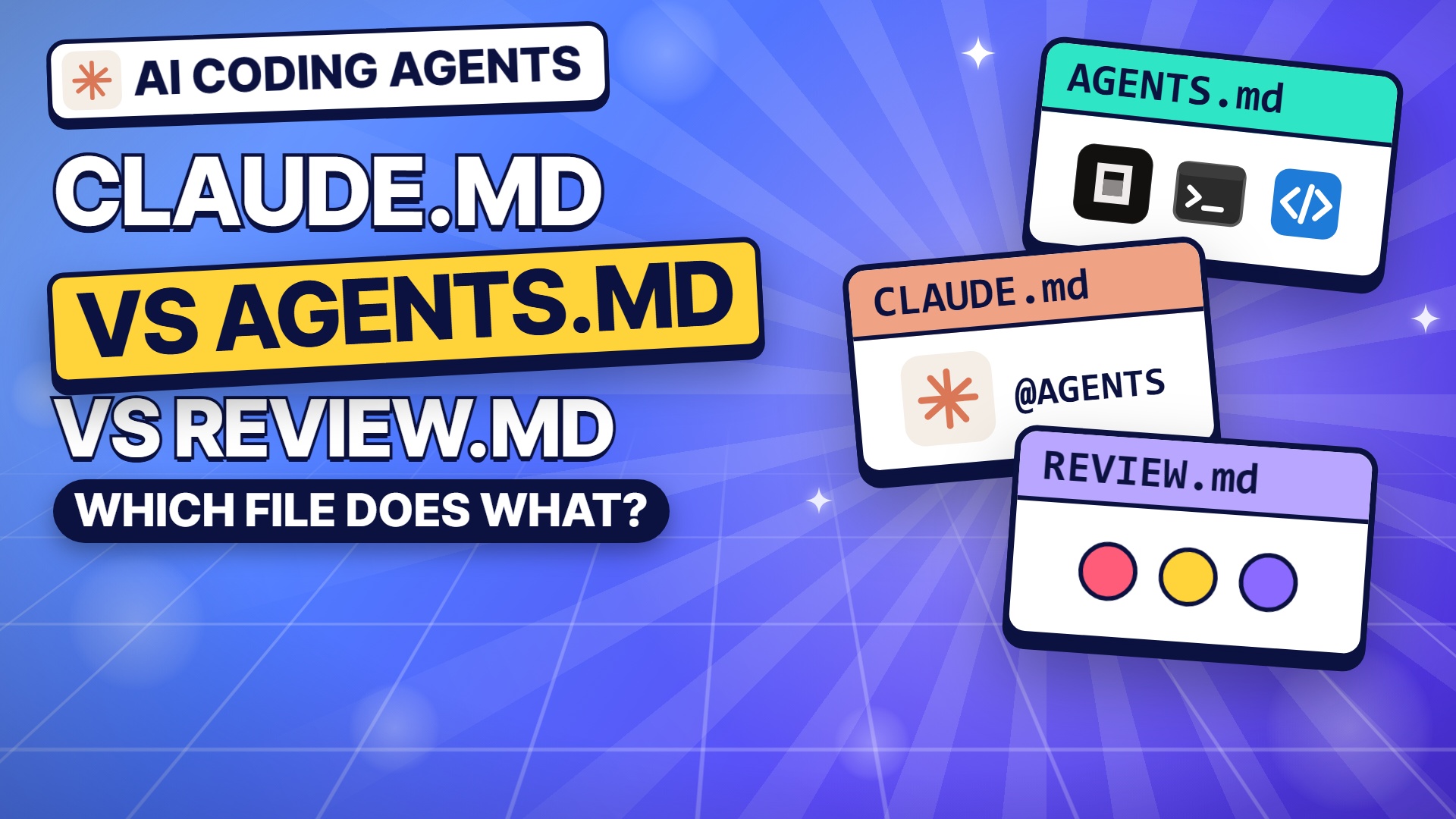
The short answer to CLAUDE.md vs AGENTS.md: they do the same job for different tools. AGENTS.md is the open standard instruction file that OpenCode, Codex, Cursor and many other agents read. CLAUDE.md is Claude Code's own version of it. REVIEW.md is something else entirely: rules for Claude Code Review, the managed reviewer that comments on your GitHub pull requests. It is only read during pull request reviews.
So two of these files give an agent project context before you type a word, and the third tunes what gets flagged in code review. Here is how they fit together, with versions as of November 2026 (Claude Code 2.1.330, OpenCode 2.3).
Both files are plain Markdown in your project: headings and bullet points. When a session starts, the agent reads the file into its context before your first message. Claude Code adds it right after its system prompt; OpenCode adds it after its own instructions. Think of it as the onboarding note you would give a new teammate.
Get 50% off on your first month with Stockimg AI Pro
AI Design Tool
50% off first month
All In One AI Design Tool
Faster than any designer
All models in one place
Nano Banana, Flux, Kling...
No design skills needed
Create with AI
Special Offer
Get 50% off on your first month with Stockimg AI Pro
AI Design Tool
50% off first month
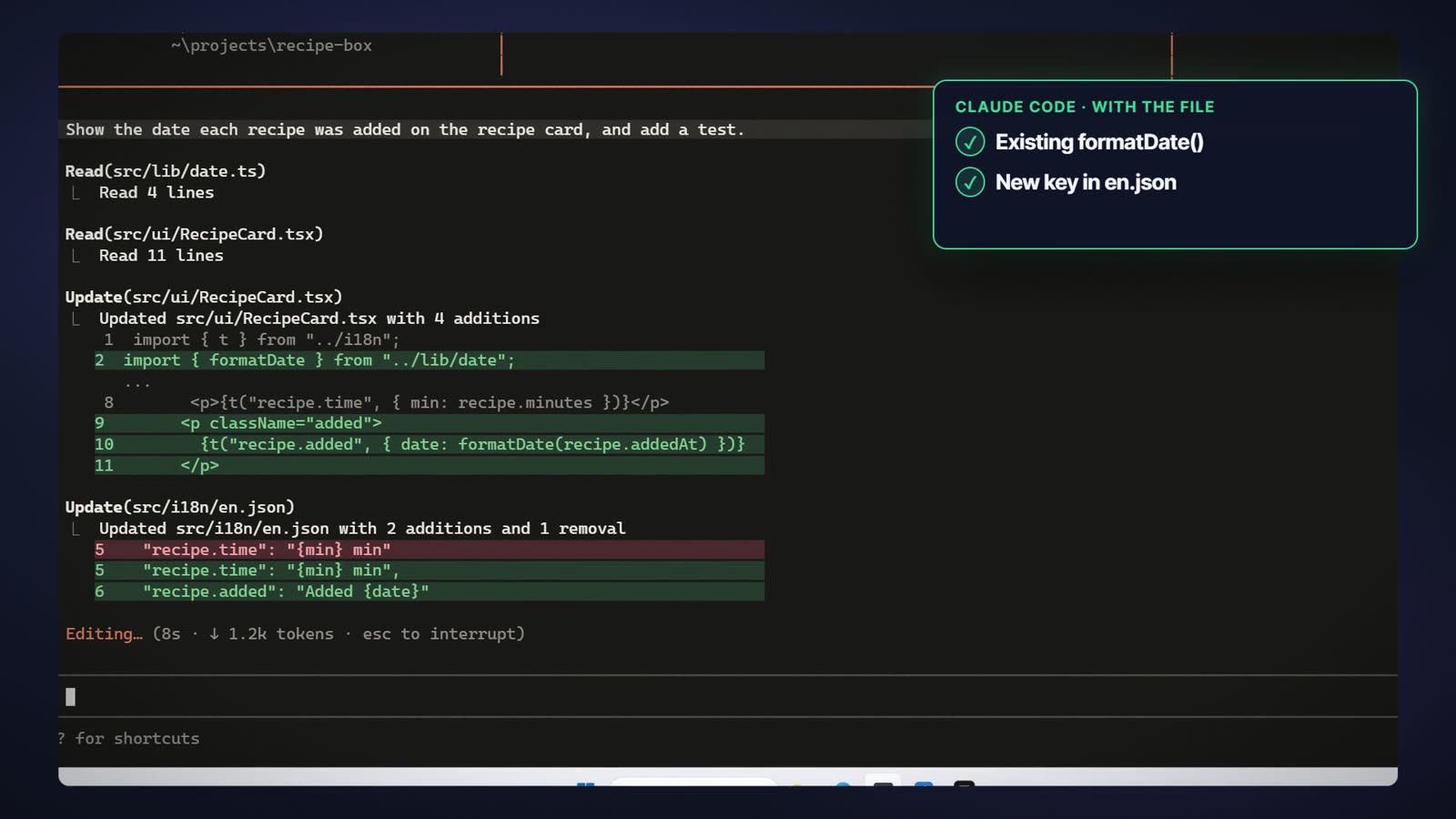
Without one, an agent behaves like a smart stranger. In a test on a small pnpm project, both Claude Code and OpenCode installed a date library with npm (creating a second lock file), hard-coded a UI label and ran the whole test suite. Nothing crazy, just wrong for that project. With the file in place, both agents used the existing date helper, added a translation key and tested only the changed file.
AGENTS.md is the open standard, stewarded by the Agentic AI Foundation under the Linux Foundation. The agents.md site says over 60,000 open source projects use it.
CLAUDE.md is what Claude Code reads first. Since version 2.1.277, Claude Code also reads AGENTS.md, but only when there is no CLAUDE.md or CLAUDE.local.md in your folder or above it. If both exist, it reads CLAUDE.md only.
OpenCode works the other way round: it reads AGENTS.md and falls back to CLAUDE.md in any folder that has no AGENTS.md.
AGENT.md (singular) is an older name some tools used. The standard's FAQ says to rename it to AGENTS.md.
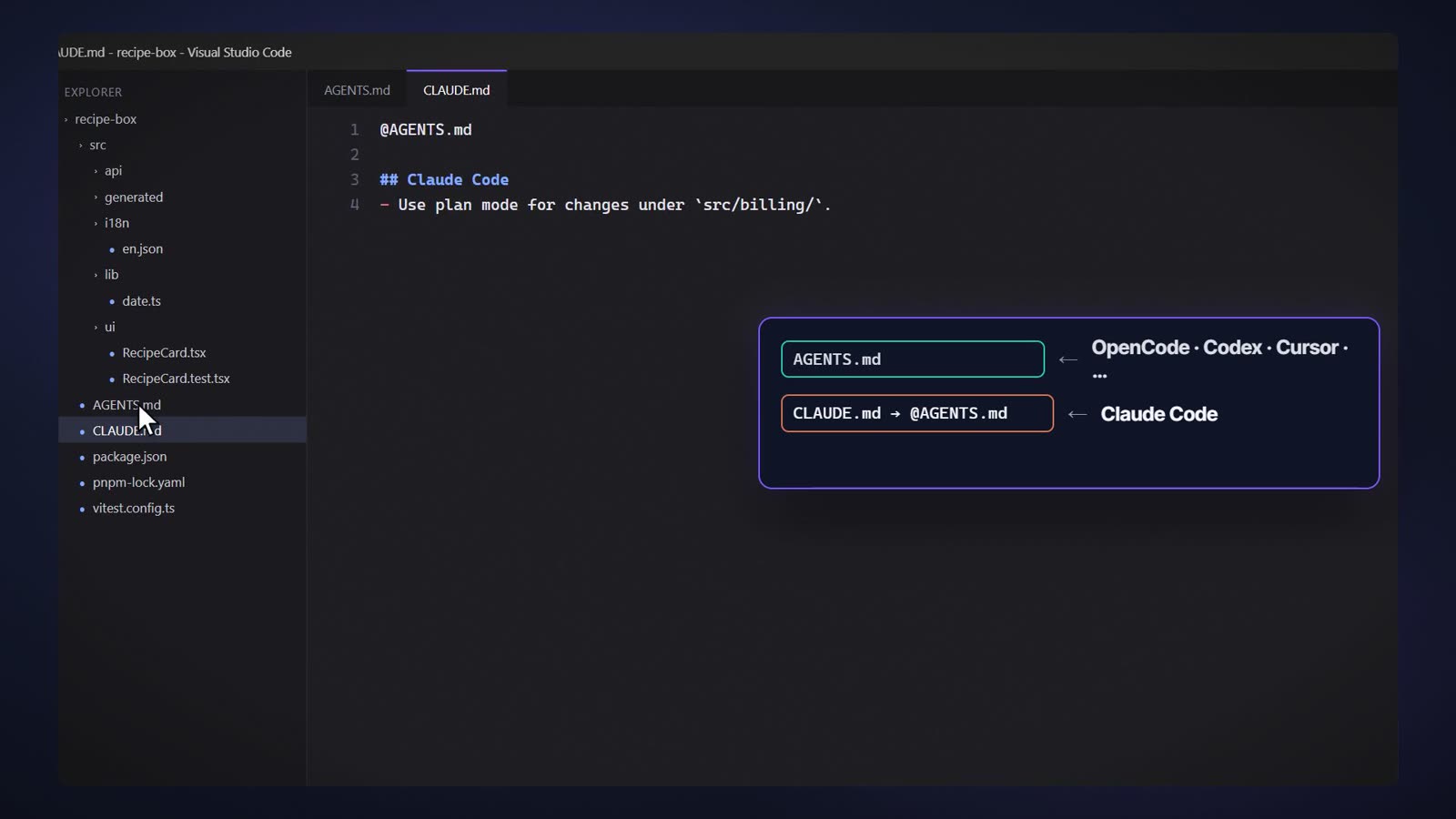
If your team uses more than one agent, don't keep two files that drift apart. Write everything in AGENTS.md, then create a CLAUDE.md next to it that imports it:
@AGENTS.md
## Claude Code- Use plan mode for changes under `src/billing/`.
The @AGENTS.md line is an import: Claude Code pulls the whole file in as if it were written there. Below it, add anything only Claude needs. OpenCode and Codex read AGENTS.md, Claude Code reads both, and nothing is duplicated.
Why not a symlink? On Mac and Linux, ln -s AGENTS.md CLAUDE.md works. On Windows, creating a symlink needs admin rights or Developer Mode, and Git checks it out as a plain text file by default, so a teammate ends up with a one-line CLAUDE.md. On Windows, use the import.
To confirm it worked, start Claude Code and run /context all. Under Memory files you should see CLAUDE.md with AGENTS.md included.
Instruction files stack; they don't replace each other. They are joined broadest first, so the one closest to your work is read last.
Level
Claude Code
OpenCode
Global (you, every project)
%USERPROFILE%\.claude\CLAUDE.md
~/.config/opencode/AGENTS.md
Project (team, in Git)
CLAUDE.md or .claude/CLAUDE.md
AGENTS.md
Subfolder (e.g. in a monorepo)
Loaded when Claude starts working on files there
Loaded when the agent starts working on files there
Codex keeps its global file in ~/.codex/AGENTS.md. Claude Code also reads CLAUDE.local.md next to the project file, for your private notes; add it to .gitignore. Good global lines are personal, like "I work on Windows, so use PowerShell". Team rules belong in the project file.
One trap: if you rely on AGENTS.md in Claude Code and then add a CLAUDE.local.md for your own notes, Claude stops reading AGENTS.md. Import it there too, or change the Project instructions setting in /config.
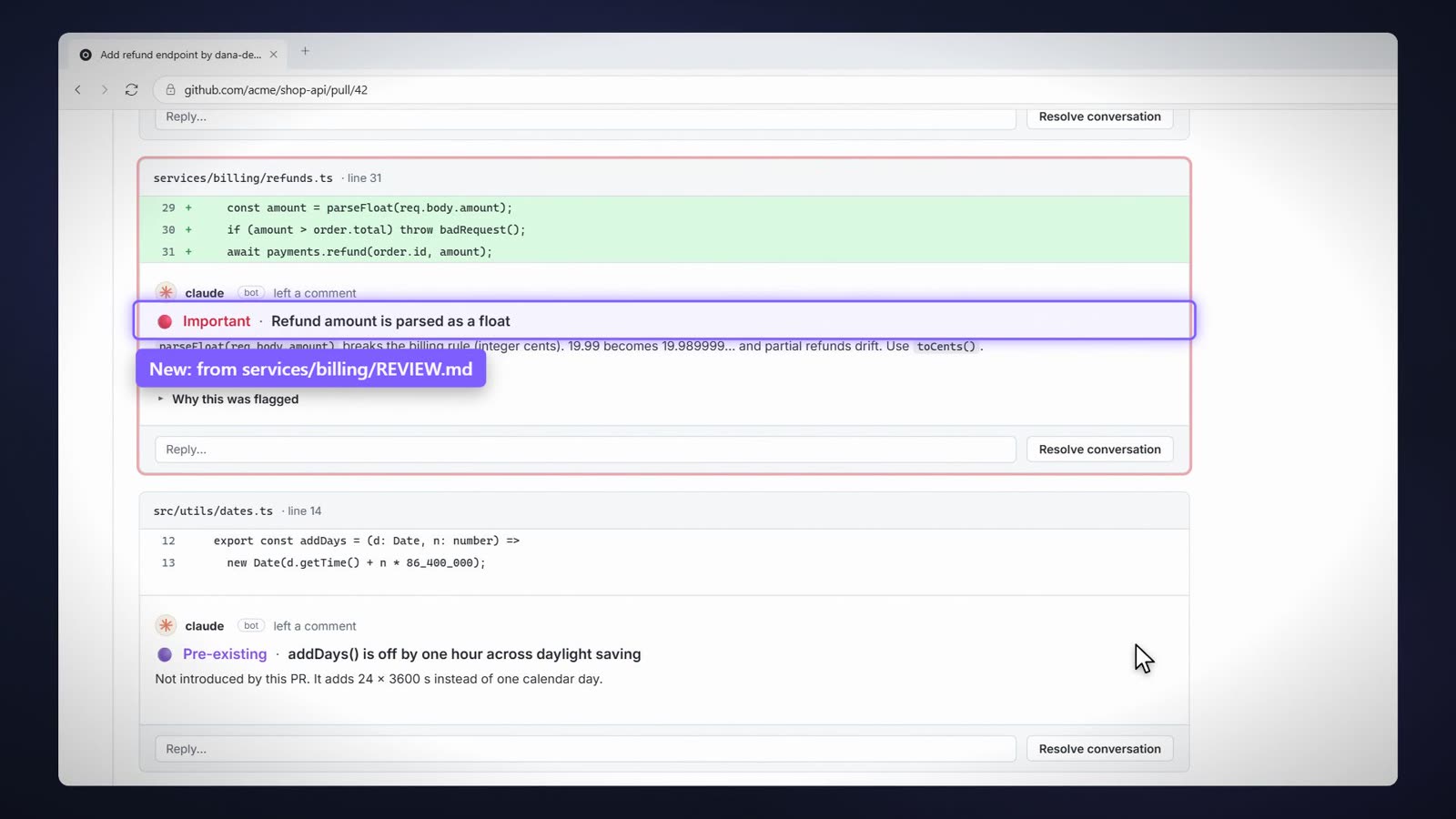
Claude Code Review is Anthropic's managed reviewer for GitHub pull requests. Several agents read the change and the code around it, a verification step throws out false positives, and the survivors are posted as inline comments with three severities: Important (fix before merging), Nit (minor) and Pre-existing (the bug was already there). It never approves or blocks a pull request.
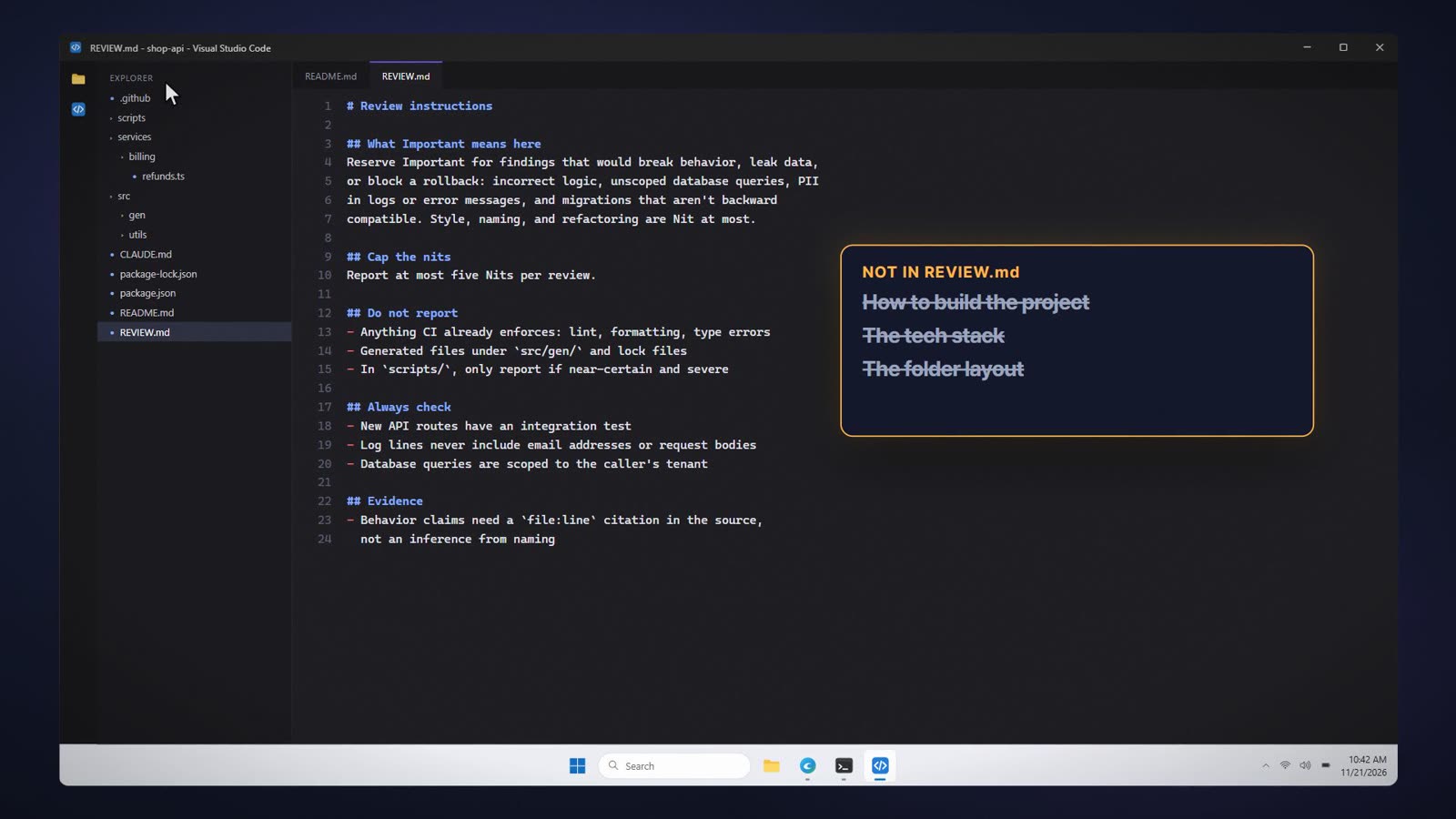
By default it focuses on correctness. REVIEW.md is how you change what it flags. A typical file is about 20 lines:
# Review instructions## What Important means here
Reserve Important for findings that would break behavior, leak data,
or block a rollback. Style, naming, and refactoring are Nit at most.
## Cap the nits
Report at most five Nits per review.
## Do not report- Anything CI already enforces: lint, formatting, type errors
- Generated files under `src/gen/` and lock files
## Always check- New API routes have an integration test
- Database queries are scoped to the caller's tenant
Notice what is not in there: how to build the project, the tech stack, the folder layout. That is general context, and it belongs in CLAUDE.md.
It is read from the base or default branch, never from the pull request. Add it in a feature pull request and that pull request is still reviewed with the old rules. Merge the file into main first.
Protect the default branch. On an unprotected branch, only the root file is read, and lowering severities, skipping paths and capping nits are not honoured.
Bigger repos can add REVIEW.md files in subfolders, such as services/billing/REVIEW.md, which add checks only for changes under that folder. Subfolder files are ignored inside folders named like tests, fixtures, examples, generated or vendor. A root REVIEW.md can also include other root files with lines like @review-security.md, eight at most.
To test a change, post a top-level comment on the pull request:
The overlap that confuses most people is between CLAUDE.md and REVIEW.md:
CLAUDE.md is read for every Claude Code task. Code Review reads it too, and flags changes that break its rules.
REVIEW.md is read only by Code Review on GitHub.
The local /code-review command in a Claude Code session reads CLAUDE.md, not REVIEW.md. /code-review --fix also applies the findings to your working tree.
So a rule you want everywhere, like "database queries are scoped to the caller's tenant", goes in CLAUDE.md (or the AGENTS.md it imports). Rules that only make sense for pull requests, like a nit cap, stay in REVIEW.md.
Yes, since version 2.1.277, but only when there is no CLAUDE.md or CLAUDE.local.md in your folder or above it. If you also have a CLAUDE.md, put @AGENTS.md in it.